Kenya starts crude oil drilling in Turkana as Gulf Energy targets December 1 first oil
Kenya has begun drilling at the Amosing oil fields in Turkana, with Gulf Energy targeting first production of more than 20,000 barrels per day from December 1, 2026.
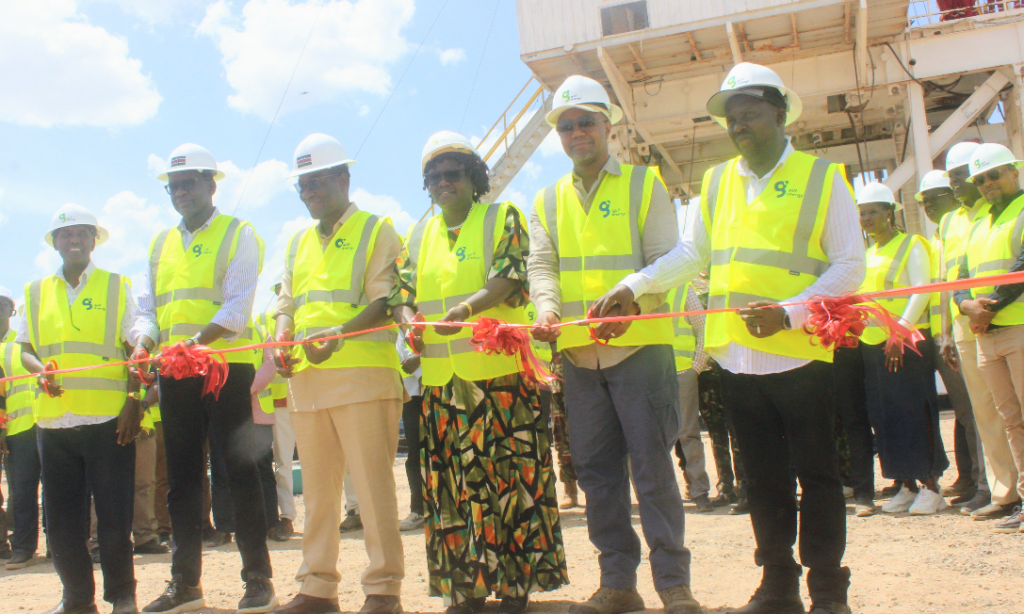
Cabinet Secretaries Davis Chirchir, Opiyo Wandayi and Beatrice Askul cut the tape during Gulf Energy Amosing Spudding
Kenya has taken a major step towards commercial crude oil production after Gulf Energy E&P BV SEZ spudded the Amosing 1 well pad in Turkana County, with the government and operator targeting December 1, 2026, for the start of first-oil production.
Spudding is the commencement of drilling operations at a well. The milestone follows the rigging, levelling and commissioning of the GW70 onshore drilling rig, leased from China’s Great Wall Drilling Company (GWDC), at the Amosing 1 and 2 oil fields.
Energy and Petroleum Cabinet Secretary Opiyo Wandayi presided over the spudding ceremony on November 20, accompanied by Roads and Transport Cabinet Secretary Davis Chirchir, East African Community Cabinet Secretary Beatrice Askul and other government officials.
Wandayi said development of the South Lokichar oil fields in Blocks T6 and T7 was progressing in line with the Field Development Plan (FDP), which was ratified by Parliament. He described the start of drilling as a historic milestone ahead of Kenya’s entry into commercial crude oil production.
“This spudding event by the Government of Kenya’s contractor, Gulf Energy E&P BV SEZ, marks a historical milestone ahead of first oil production,” Wandayi said.
He said the government was supporting efforts to accelerate development of the oil fields, adding that he was impressed by the professionalism and commitment demonstrated by Gulf Energy and its contractors as they work towards the FDP targets.
In the first phase, Gulf Energy is expected to focus on the Ngamia, Amosing, Twiga and Ekales fields, collectively known as NEAT, with a planned production capacity of more than 20,000 barrels per day.
The six discoveries targeted under the project have a best-estimate recoverable resource of 326 million stock-tank barrels over a 25-year contract period, according to the project details presented at the ceremony.
Gulf Energy plans to transport crude oil to Mombasa
Gulf Energy E&P BV SEZ Managing Director Paul Limoh said the company’s systems were ready for the first phase, with the initial 20,000 barrels per day expected to be transported by road to Mombasa from December 1 for storage at the Kenya Petroleum Refineries Limited tank farms.
The company plans to raise output to 50,000 barrels per day in the second phase of development.
“At Gulf Energy, we are maintaining a tight delivery and project management schedule with the support of all our stakeholders, with a pledge to deliver against the FDP to world-class standards,” Limoh said.
Limoh said the company was targeting six discoveries across Blocks T6 and T7, with an estimated 326 million stock-tank barrels recoverable over the 25-year contract period.
For the first phase, Gulf Energy has contracted Baker Hughes to provide integrated well services, while energy technology company SLB has been engaged to deliver the Early Production Facility (EPF).
Government commits KSh24 billion to infrastructure
Chirchir said the government was investing more than KSh24 billion in infrastructure projects, including roads in the oil fields region, to support development and improve connectivity.
He said the infrastructure investment would help raise the region’s social and economic standing as oil field development progresses.
Kenya crude oil characteristics and projected revenue
Kenya’s crude is described as low in sulphur, asphaltene and aromatics, but moderately high in wax content. It has a high wax appearance temperature and a pour point above ambient conditions. The associated gas is rich and sweet, although some areas have elevated carbon dioxide content.
The crude is expected to be an intermediate, paraffinic and sweet oil, with an API gravity of 30.5 degrees, and will be indexed to Dated Brent.
The government projects that development of the South Lokichar Basin oil fields could generate more than US$2.9 billion (about KSh371 billion) in lifetime earnings. The actual returns will depend on international oil prices and production volumes over the life of the project.
Gulf Energy will operate the project fields under Production Sharing Contracts with the National Government, with oversight by the State Department for Petroleum and the Energy and Petroleum Regulatory Authority (EPRA).
The spudding marks the start of the drilling phase of the development programme in Turkana, ahead of the planned December 1 first-oil date.