Wavinya Ndeti defends supplier payments, clarifies pending bills after Sammy Kioko incident
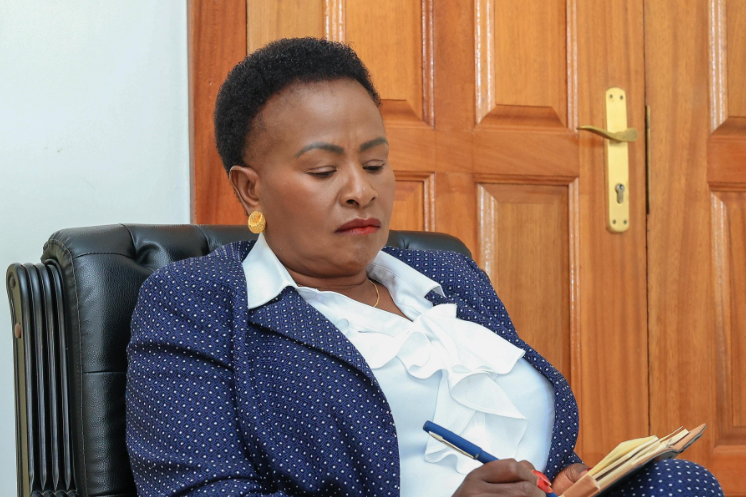
Machakos Governor Wavinya Ndeti
Machakos Governor Wavinya Ndeti has moved to clarify the status of pending supplier payments and defend her administration’s record, following recent tensions in Machakos Town involving a local businessman.
In a detailed statement, the governor addressed concerns raised by Sammy Kioko over alleged non-payment for supplies, while also condemning an incident that occurred in the town on March 31, 2026.
“First and foremost, I express concern over the unfortunate incident that occurred in Machakos Town on 31st March, 2026. As a County Government, we do not condone violence in any form and we urge all parties to exercise restraint and allow lawful and orderly processes to prevail,” she said.
Supplier dispute clarified
Ndeti dismissed claims that Kioko is a registered supplier to the county, stating that official records indicate the contract in question was awarded to Movata Designs.
“Our records indicate that Mr. Sammy Kioko is not a registered supplier of the County Government of Machakos. The entity that supplied Inspectorate uniforms is Movata Designs,” she said.
She added that any individual purporting to act on behalf of the company must provide proper legal authorization, including a power of attorney, formal appointment, or representation by a qualified advocate.
The governor confirmed that supplies were indeed made by the firm but said the process was incomplete.
“We acknowledge that supplies were made by Movata Designs, however, partial delivery occurred towards the close of the financial year 2023/2024 and therefore inspection and acceptance of the partial delivery could not be conducted,” she said.
As a result, the claim was classified as a pending bill in line with provisions of the Public Finance Management Act.
Billions under verification
Ndeti said her administration established a Pending Bills Committee to audit inherited obligations, following recommendations from the Office of the Auditor-General and the Office of the Controller of Budget.
The verification process covered pending bills amounting to KSh 3.81 billion.
“Upon completion of this exercise, the Committee established that KES 2,126,781,000 constituted eligible (payable) pending bills, while KES 1,685,475,795 were ineligible claims,” she said.
The ineligible claims included KSh 927.5 million in unverified legal fees and KSh 757.8 million tied to incomplete documentation.
Payments made and balances
Since taking office, the governor said her administration has already settled KSh 642.3 million of the verified historical pending bills, leaving a balance of KSh 1.48 billion.
She added that the remaining amount will be cleared progressively through the Supplementary Budget for the 2025/2026 financial year and subsequent budgets.
“Out of the eligible historical pending bills of KES 2,126,781,000, we have already settled KES 642,345,765, leaving a balance of KES 1,484,435,235,” she said.
In addition, the county has paid KSh 1.39 billion in pending bills within the first seven months of the current financial year.
“This is a clear demonstration of our commitment to restoring fiscal discipline and honoring obligations,” Ndeti said.
Plan to clear current bills
The governor outlined a structured plan to clear current pending bills amounting to KSh 1.96 billion.
So far, KSh 249.8 million has been processed under a first-charge arrangement, while KSh 300 million has been included in the 2025/2026 supplementary budget. A further KSh 846 million has been proposed in the 2026/2027 budget estimates, with the remaining KSh 572 million set to be cleared in the next financial year.
“I wish to assure all suppliers and the public that the County Government remains fully committed to settling all verified and legitimate claims,” she said.
However, she emphasized that payments must follow strict legal and financial frameworks, including the First-In, First-Out (FIFO) principle to ensure fairness.
Delays linked to exchequer releases
Ndeti also pointed to delays in disbursements from the national government as a key challenge affecting counties.
“It is also important to note that County Governments depend on disbursements from the National Exchequer. Delays in these disbursements have affected the pace at which payments can be made, not just in Machakos County, but across all counties,” she said.
Call for patience
While acknowledging frustrations among suppliers, the governor urged them to follow formal channels rather than resorting to protests.
“Public demonstrations and media campaigns, while understandable, cannot override lawful procedures nor accelerate payments beyond what is provided for within the law,” she said.
She reaffirmed her administration’s commitment to transparency and accountability, pledging that all verified claims will eventually be settled.
“Government is a perpetual institution, and all verified obligations will be honored in due course,” she said.
Background
Pending bills have been a persistent challenge for county governments in Kenya, often arising from delayed payments, disputed contracts, and incomplete documentation. Oversight bodies such as the Auditor-General and Controller of Budget have repeatedly called for stricter verification processes to curb irregular claims and ensure prudent use of public funds.
Machakos County, like many others, inherited a backlog of unpaid obligations, prompting the formation of verification committees to audit and validate claims before payment.