Sakaja Under Pressure to Explain Alleged New Online Liquor Levy as Traders Raise Alarm

Nairobi Governor Johnson Sakaja. [Photo/@SakajaJohnson/X]
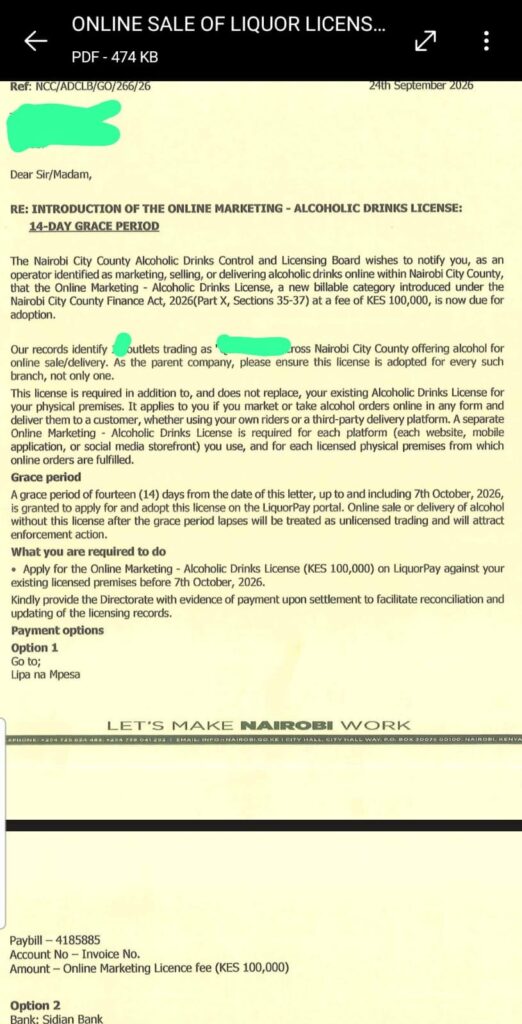
Nairobi liquor traders have called on Governor Johnson Sakaja to explain an alleged KSh100,000 charge targeting businesses selling alcoholic drinks through online shopping and delivery platforms, warning that the additional cost could place further pressure on their operations.
The traders are questioning why businesses that already pay applicable county licensing fees should face another charge for taking orders and delivering products through digital platforms.
The reported levy has sparked questions about its legal basis, how it would be applied and the enforcement measures allegedly used against businesses that fail to pay.
Traders want the county government to clarify whether the charge is compulsory, which businesses it covers and the law under which it is being imposed.
Traders raise cost concerns
Liquor businesses already contend with expenses such as rent, salaries, stock and existing licences. An additional KSh100,000 payment, if confirmed, could add to their operating costs.
The traders are particularly concerned about how the charge would affect outlets using services such as Glovo and other platforms to receive and fulfil customer orders.
They want to know whether the payment would be charged once per business or separately for each online shop or delivery platform.
The distinction is important for outlets that use more than one platform to reach customers, as multiple charges could increase the cost of doing business online.
Traders are asking the Sakaja administration to publish the relevant legislation and fee schedule so that businesses can establish what they are legally required to pay.
“A liquor seller using Glovo, UberEats, BoltFood, Jumia or any online store now has to pay additional levies to Sakaja’s men of Ksh100,000 per location for each platform,” a trader who sought anonymity said.
Claims of raids, confiscations
The controversy has also been accompanied by allegations that county enforcement officers, commonly known as Kanjo, raid businesses that do not pay the reported levy.
Traders further allege that such operations have involved the confiscation of stock and the arrest of employees.
The claims require independent verification and a response from the county government. The available material does not establish the circumstances of the alleged incidents or identify the specific legal provisions under which the reported actions were taken.
The traders want the county to explain the legal procedures governing enforcement and provide a clear mechanism for businesses to challenge disputed charges.
They argue that revenue collection should be accompanied by transparent rules and enforcement procedures that businesses can understand and follow.
Calls for accountability
The dispute has placed the spotlight on how county governments introduce, communicate and enforce business-related charges.
While counties have a mandate to collect revenue in accordance with the law, traders need to know which fees apply to their businesses and whether any additional payments have a valid legal basis.
“For Nairobi liquor traders, the immediate questions are whether the alleged KSh100,000 levy is authorised by law, why it is necessary for businesses that already hold relevant licences and what protections are available to those contesting it,” one trader said.
“The county administration is being urged to address these concerns and explain whether the reported charge applies to all liquor businesses selling online or only to particular categories of operators.”