Wawira Njiru Wins Prestigious German Africa Prize for Feeding 660,000 Kenyan Schoolchildren

Wawira Wanjiru
Kenyan social entrepreneur Wawira Njiru has been selected for the German Africa Prize in recognition of her work in transforming school feeding and tackling hunger among children across the country.
Njiru, the founder of Food4Education (F4E), started the initiative while she was still a student, initially providing meals to 25 schoolchildren. Her ambition at the time was to expand the programme and ensure 100 children could receive a meal each day.
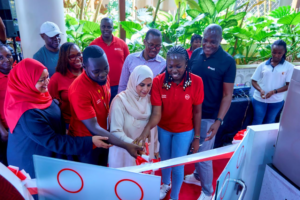
The initiative has since grown into one of Kenya’s largest school-feeding programmes, reaching more than 660,000 children in over 1,900 schools across the country.
The German Africa Foundation (DAS) said Njiru’s work had demonstrated how a social initiative can develop into a sustainable system that benefits children while also supporting families and local economies.
Claus Stäcker, chair of the independent Africa Prize jury and director of Africa programmes at Deutsche Welle, described the Food4Education model as “an African solution to a global problem.”
He said Njiru had turned an idea initially rooted in charity into a functioning school-feeding system that reaches children, involves families and contributes to local economic activity.
Linking school meals to farmers
Food4Education’s model goes beyond providing meals to schoolchildren by incorporating local farmers into its supply chain.
About 80 per cent of the food supplied through the organisation is sourced from small-scale farmers, creating a market for their produce while helping provide fresh food to pupils.
The approach is designed to create a cycle in which school feeding supports both nutrition and local agricultural livelihoods.
“For a long time, school meals were viewed as charity. We’ve proven that it’s economic infrastructure,” Njiru said.
The programme operates within a broader school-feeding landscape in Kenya where meals are funded through a combination of parental contributions, government support and donations.
From 25 children to more than 660,000
Njiru said the growth of Food4Education had required persistence and a willingness to challenge assumptions about what could be achieved.
The 35-year-old entrepreneur described herself as “stubborn” when pursuing her goals, saying she does not easily accept that an idea is impossible.
“I’m stubborn. Once I figure I want something, I try and work towards it. And, you know, it’s hard to tell me something is not possible,” she said.
She credited the award to the wider Food4Education team, which she said includes about 6,000 staff working to ensure children receive meals.
“It’s an incredible honor for me and for all of Food4Education, our 6,000 staff who wake up every day to make sure that kids are fed,” Njiru said.
Food4Education has also expanded its role beyond Kenya, assisting other governments seeking to develop school-feeding programmes suited to their own local circumstances.
Prize to be presented in Berlin
The German Africa Foundation is a non-partisan organisation that promotes engagement with Africa in German political and public circles.
Since 1993, the foundation has awarded the German Africa Prize to individuals whose work contributes innovative approaches to major challenges and whose ideas have relevance beyond their home countries.
The award has previously recognised individuals from countries including Zimbabwe, Cameroon and Sierra Leone.
German Federal Minister for Economic Cooperation and Development Reem Alabali Radovan is scheduled to present the prize to Njiru on November 4 at the Allianz Forum in Berlin.
Njiru’s recognition places Kenya’s school-feeding efforts on an international platform and highlights the potential of combining nutrition programmes with local agricultural supply chains to address hunger while supporting economic activity.